GPT-5.4 dropped. The hype isn't fully justified, but the shift is real
GPT-5.4 came out on March 5, 2026, and within hours my feed was full of people calling it a breakthrough.
I'm a bit more skeptical.
The model is better, no doubt. But if you've been paying attention to the last few releases, you'll notice a pattern: the raw logical reasoning doesn't feel dramatically smarter with each version. What does improve (and what I think people are actually responding to without realizing it) is how much better these models get at understanding what you're asking for. The conversational layer, the intent parsing, the way it doesn't misread your prompt anymore.
That's useful. But it's not the same as becoming more intelligent.
What actually changed in GPT-5.4
OpenAI is marketing this one around reasoning and coding improvements. There are also "Thinking" and "Pro" variants for deeper analysis and enterprise workloads.
The context window is the thing that's actually interesting to me. Reports suggest it's pushing toward one million tokens, which means you can feed it:
- An entire codebase
- A long chain of log files
- Months of documentation
...and ask questions about all of it in one shot.
Full-repo code assistant
├── Ingest entire codebase
├── Understand cross-file dependencies
├── Suggest refactors across modules
└── Answer questions with full context
That's not a gimmick. For developers building AI tooling, larger context genuinely unlocks things that weren't feasible before.
The agentic workflow improvements are also worth noting. GPT-5.4 is designed to work inside systems that take actions autonomously, not just answer questions. But again, I'd temper expectations here. Better at following multi-step instructions is not the same as actually reasoning through hard problems differently.
My honest take on the plateau
I keep seeing people benchmarking these models on math olympiad problems or logic puzzles to prove they're getting smarter. And yes, the scores go up. But when I actually use them day-to-day for real engineering problems, like debugging something subtle, thinking through a design tradeoff, or understanding why a system behaves a certain way, it still falls apart in familiar ways.
What has noticeably improved across GPT-4, 4.5, and now 5.x is how rarely the model misunderstands your intent. Earlier versions would latch onto the wrong part of your prompt. That happens much less now. The model is better at being a good conversation partner.
That's a real improvement. I just don't want to confuse it with the model becoming fundamentally better at reasoning.
The thing that does matter for developers
Even if the intelligence plateau is real, the broader shift it's part of is not something to dismiss.
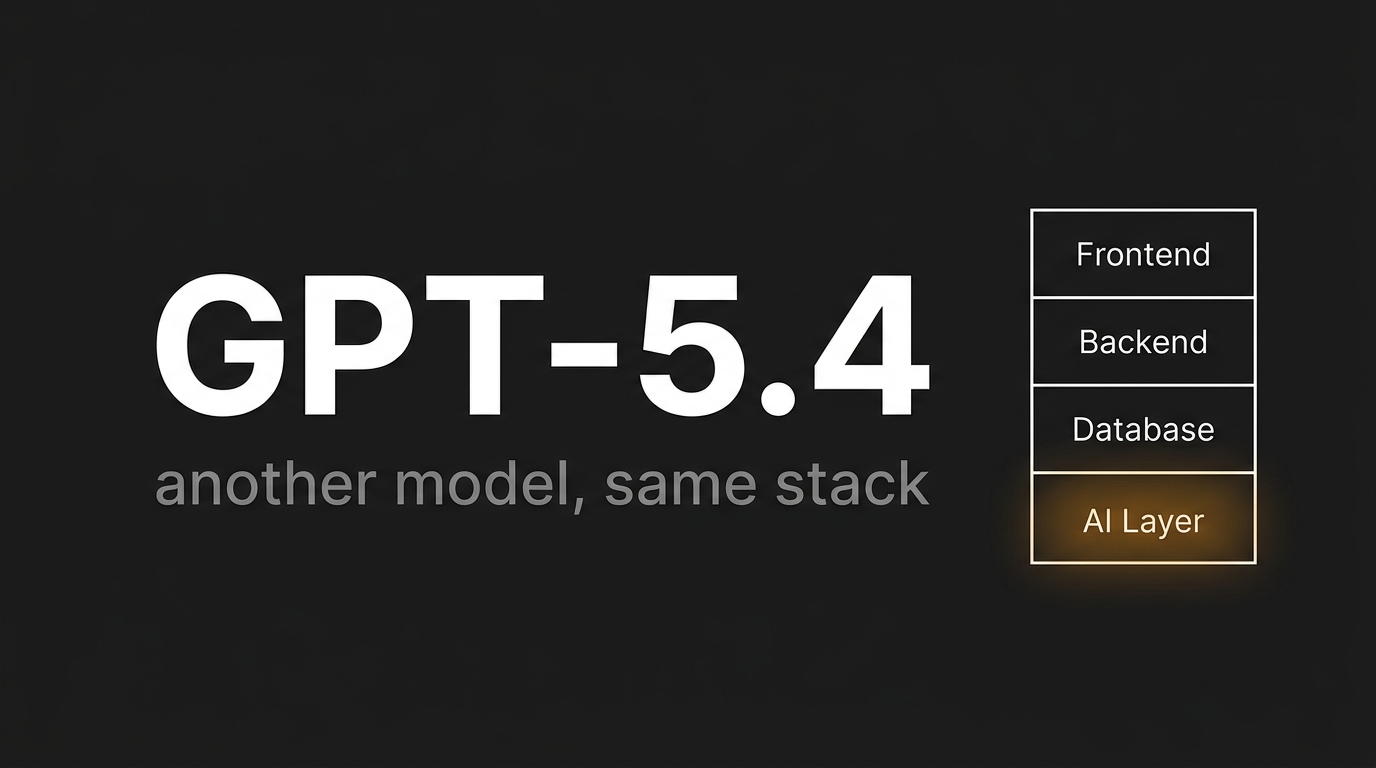
AI is becoming infrastructure. Not in a hype way, more like the same boring, practical way that databases and message queues became infrastructure. Something you design around, not something you bolt on.
Applications are increasingly built with an explicit AI layer:
┌─────────────┐
│   Frontend  │
├─────────────┤
│   Backend   │
├─────────────┤
│  Database   │
├─────────────┤
│   AI Layer  │  ← this is just part of the stack now
└─────────────┘
And the patterns that sit in that layer are maturing fast, regardless of which model you plug in.
Patterns worth actually learning
If you're going to invest time in this space, focus on the patterns that don't change every time OpenAI ships a new model.
RAG (Retrieval-Augmented Generation)
The idea is simple: instead of relying on what the model memorized during training, you pull in relevant data at query time and hand it to the model as context.
User query
   ↓
Embed query as vector
   ↓
Search vector database
   ↓
Retrieve relevant documents
   ↓
Pass context + query to model
   ↓
AI generates grounded answer
This pattern works with GPT-4, GPT-5.4, Claude, Gemini. The model is almost interchangeable. Getting the retrieval right is the hard part.
Agents
An agent is just a model that can call tools in a loop until it completes a task. The workflow looks something like this:
User request
     ↓
AI plans tasks
     ↓
Calls tools (search, code exec, APIs)
     ↓
Writes code
     ↓
Tests code
     ↓
Returns result
Whether GPT-5.4 is smarter or not, more reliable intent parsing means agents fail less silently. The model is less likely to misinterpret what tool to call or when to stop. That's where the conversational improvements actually translate into something concrete.
Plugging AI into real pipelines
The most underrated use of these models is as a processing step inside existing infrastructure. Log triage is a good example:
const result = await openai.chat.completions.create({
  model: "gpt-5.4",
  messages: [
    {
      role: "system",
      content:
        "You are an on-call engineer. Classify this log entry and suggest a root cause.",
    },
    {
      role: "user",
      content: logEntry,
    },
  ],
});
Data classification, document tagging, summarization. That's where I think AI earns its place in the stack right now. It's not glamorous but it works, and the bar for "good enough" is low enough that even a less-than-perfect model handles it fine.
So should you care about GPT-5.4 specifically?
Honestly, probably not that much.
If you're already building with GPT-4 or similar, the upgrade path is real and the context window improvements are worth testing. But the breakthrough framing in the press and on social media feels overcooked.
The more interesting question isn't "how smart is this model" but "how is AI changing what I have to build and how I build it." That question has a clear answer: AI is becoming a standard layer in software architecture, and the patterns around it are worth investing in now regardless of which model sits underneath.
The intelligence plateau might be real. The infrastructure shift definitely is.